
A magical touch
How our hands shape our spiritual beliefs

Dear readers ✨
Long before humans organized the stars into astrology or recorded stories in writing, the influence of the hands was already embedded in the way we experienced and understood the world. Across civilizations, the hand became a universal metaphor for action, power, generosity, skill, relationship, and creation.
And so, for today's topic, I’d like explore a few ways in which the human hand came to carry such a profound symbolic weight, representing blessing, healing, creation, and connection.
The Manipulators of Our World
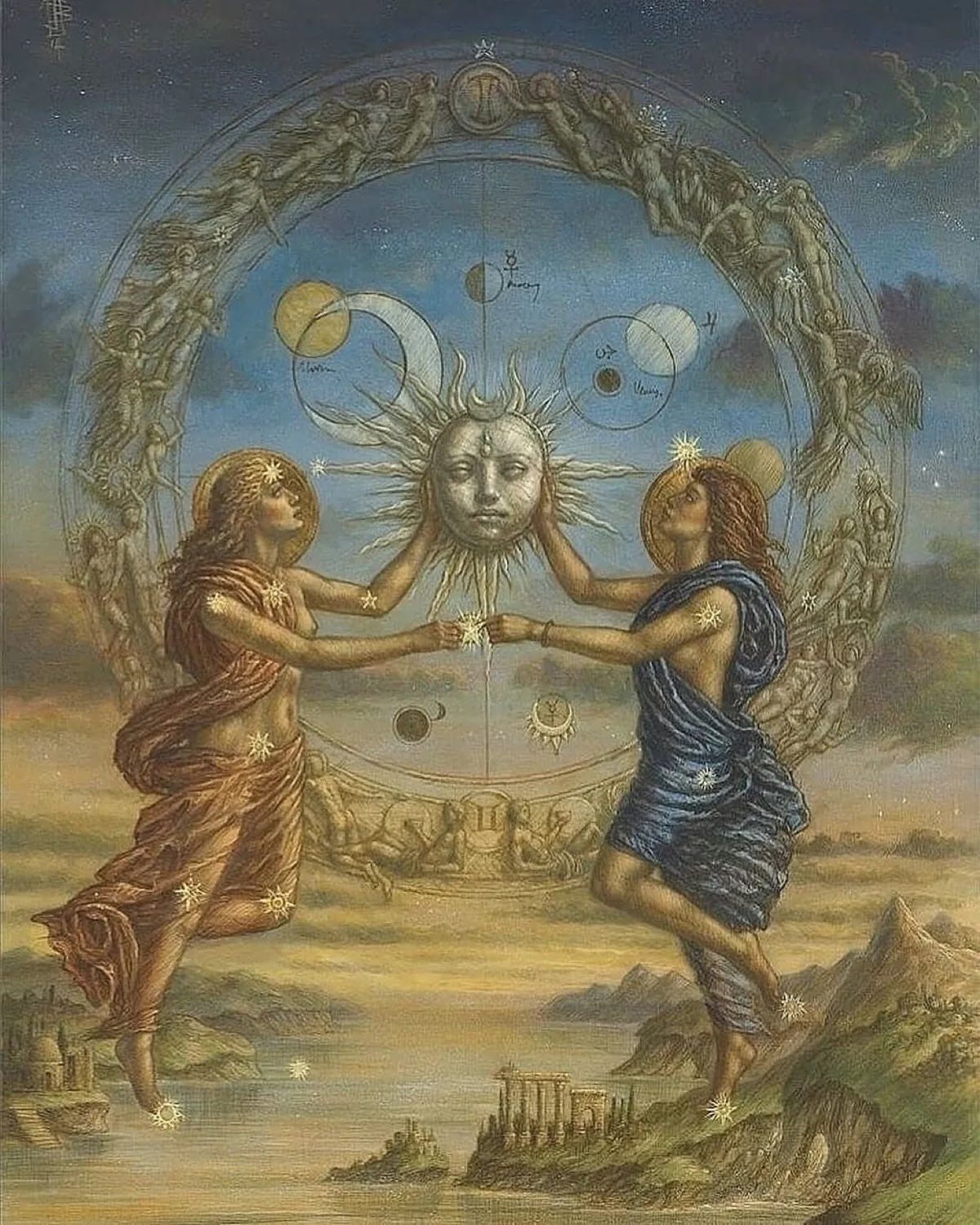
To start, let us briefly go back to Gemini, where this series began a few essays ago.
Traditionally, Gemini is associated with the hands, while Mercury, its ruling planet, governs the mind, language, communication, persuasion, trade, and the exchange of information.
Together they form a symbolic circuit: the mind that generates ideas, and the hands that give those ideas form.
The parallels, when we notice, are striking. Our hands are instruments of communication, dexterity, and duality. They represent the similar but distinct, two counterparts mirroring Gemini’s twin nature.
Here is something funny, whether you’re a seasoned astrologer or someone who’s spent five minutes in pop-astrology circles, you’ve probably encountered the claim that Gemini is the most “manipulative” sign of the zodiac.
Whether that’s true however, is another matter entirely. What interests me more is the language behind the accusation.
Take for example the word *manipulation*, we find it's roots come from the Latin *manus*, meaning “hand.”
Originally, to manipulate simply meant to handle something with the hands. Only later did it acquire the meaning and connotations of influencing people, ideas, or situations.
That evolution feels surprisingly fitting. First came the hands. Then came the tools, materials, and eventually the ideas and concepts shaped by them.
The Language of the Hands
Even today, our most abstract thinking remains rooted in the vocabulary of touch. I'll show you a few examples of what I mean.
We:
Grasp ideas.
Handle problems.
Point out errors.
Lend a hand.
Take matters into our own hands.
Refuse handouts.
Can’t quite put our finger on something.
And if that wasn't enough, the symbolism extends even further:
Power and Authority
Upper hand
Hands are tied
Under someone’s thumb
Rule with an iron fist
Hand over power
Honesty and Deception
Underhanded
Sleight of hand
Show your hand
Force someone’s hand
Caught red-handed
It can almost be said that language preserves a symbolic fossil record of the human mind. Every time we invoke the imagery of the hands, we may be echoing one of humanity’s oldest ways of understanding action, and intention.
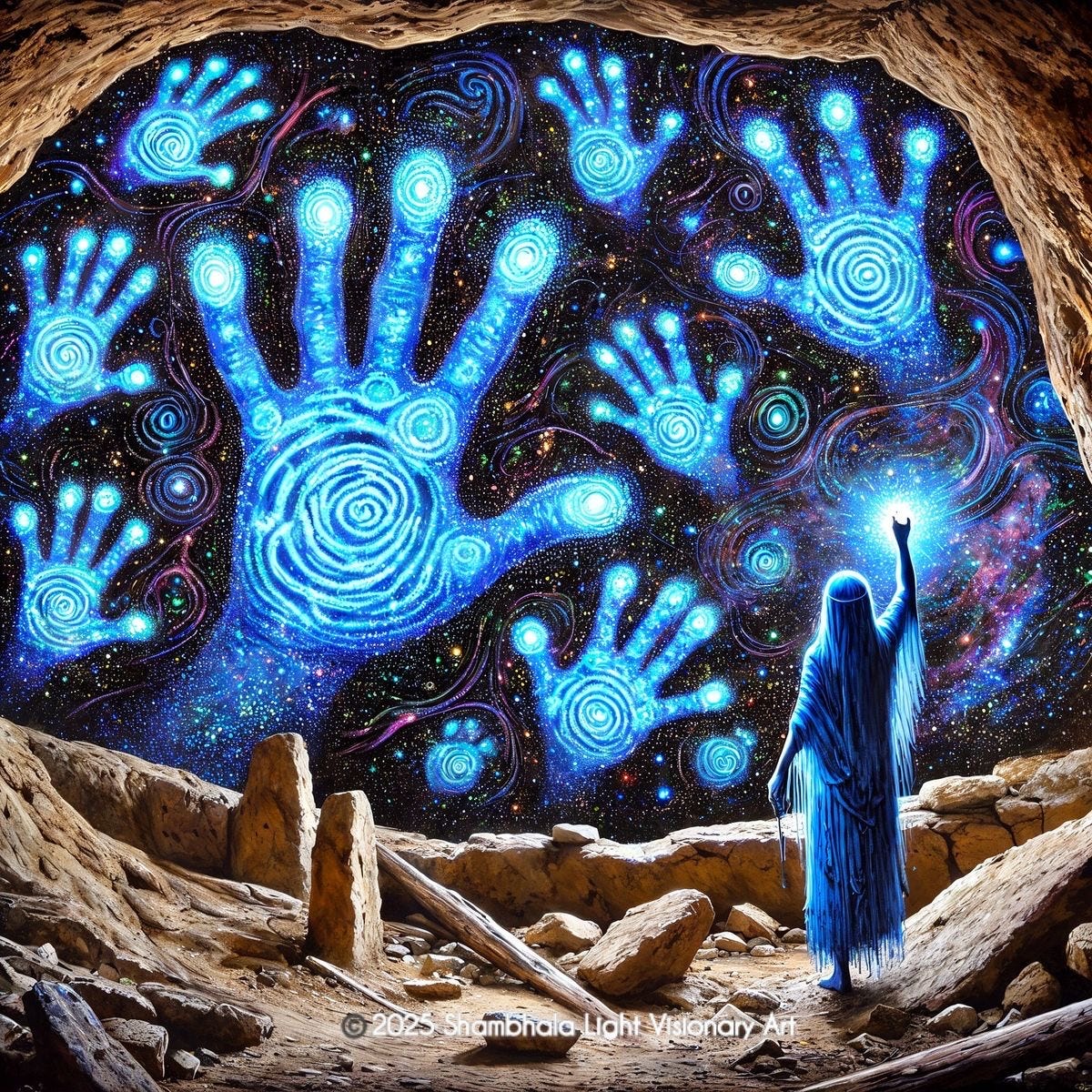
In fact, Some of the oldest known cave art consists of hand stencils, people pressing their hands against stone walls to leave behind a simple but profound message:
I was here.
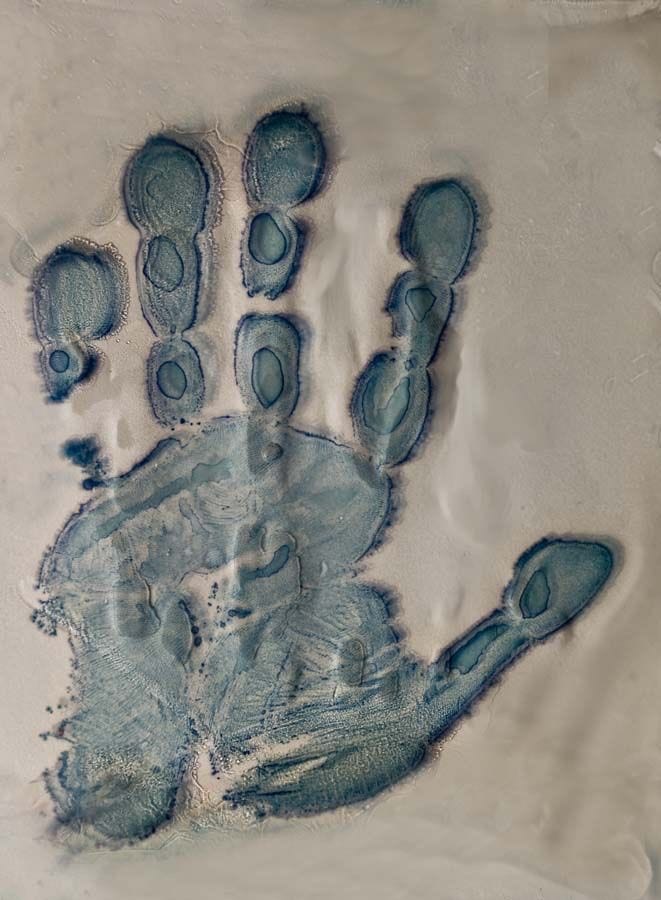
The hand became a symbol of agency, identity, and presence.
This same pattern repeats throughout human life. We imagine a possibility, move toward it, gather the knowledge and tools we need, and gradually transform imagination into reality.
In a sense, our hands made us magicians of the world. The magician’s greatest illusion is convincing us that the wonder lies in the trick. In truth, the real miracle is the quickness of the hand itself.
Every civilization, every cathedral, every loaf of bread, every child’s cradle, every written poem, every act of healing began not with magic, but with a pair of human hands. Before they became symbols of the supernatural, our hands were already performing miracles and witchcraft in the natural world.
The Divine Hand
Perhaps it is no surprise, then, that religions around the world came to use the hand as a symbol of divine action.
In the Abrahamic traditions, we encounter phrases such as “the hand of God”, not because God is imagined as literally possessing a human hand, but because the hand symbolizes the power to guide, protect, judge, create, and sustain.
Likewise, many creation stories describe a creator not simply speaking the universe into existence, but crafting it. God appears as a potter shaping clay, an architect drawing plans, or a sculptor bringing order to formlessness. Each image extends the symbolism of the human hand onto a cosmic scale.
The same symbolism appears across cultures:
In Christianity, divine blessing is often depicted through an extended hand.
The Hamsa, or Hand of Fatima, became a symbol of protection throughout the Islamic world and beyond.
In Hinduism and Buddhism, sacred hand gestures known as mudras communicate different spiritual teachings and states of consciousness.
Ancient Egyptian art frequently portrays gods extending their hands to bestow life, authority, or divine power.
Although these traditions differ greatly, they repeatedly return to the same image: the hand as the instrument through which unseen intention becomes visible action.
Where Mind Meets Matter
The hand occupies a remarkable position between thought and reality.
Intention, becomes reality through movement and application of it.
A thought remains invisible until the hand acts.
As humans became increasingly dependent on their hands for toolmaking, art, agriculture, writing, and technology, we may have unconsciously projected this experience onto the cosmos itself.
Because We create through our hands, we imagine creation emerging through a greater Hand.
Perhaps this is why the image of God as a sculptor resonates so deeply. When we perceive beauty, order, and pattern in the world, we instinctively imagine a maker working behind the scenes much as our own hands work behind everything we create.
Before there were temples, scriptures, or philosophies, there were eyes searching distant horizons, feet carrying people into the unknown, and hands shaping stone, weaving baskets, painting cave walls, and caring for children.
The sacred emerged not only from abstract thought, but from this deeply embodied human experience: first we see, then we seek, then we create.
The First Great Extension of the Hand
Yet the story doesn’t end there, dear readers, this is just the beginning of a whole new thread.
Among all the tools our ancestors would eventually create, one stood apart from the rest.
It was more than another invention. It amplified everything our hands had already become capable of doing. It transformed food, reshaped landscapes, extended the day, protected communities, and accelerated human civilization itself.
And that tool, my friends, was fire.
A new creation
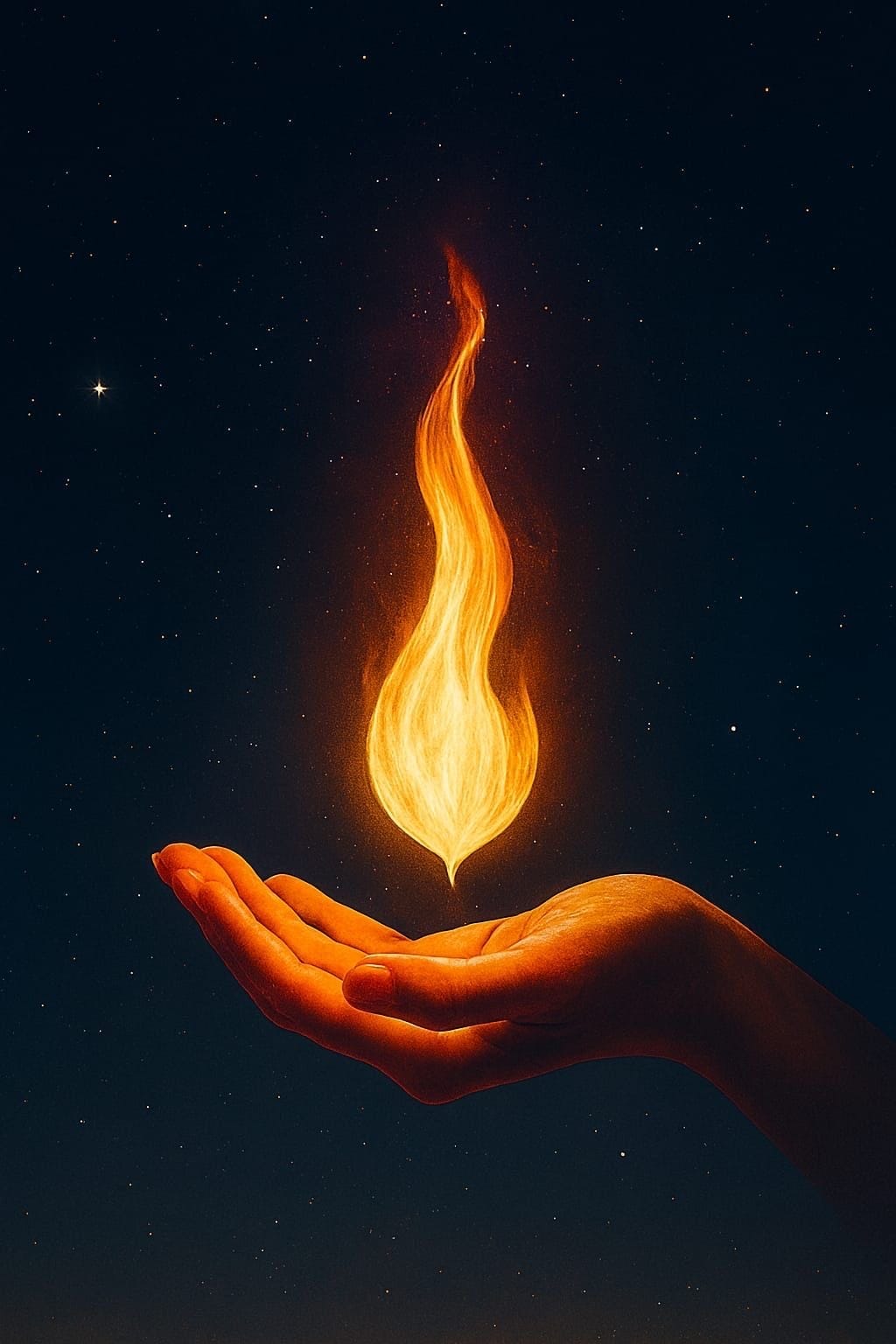
Fire presented our ancestors with a unique challenge. Unlike a stone tool or a branch, fire is not a physical object that can simply be picked up and carried. It must be carefully managed, fed, transported, and contained.
This is where the human hand may have played a crucial role. Our unusually dexterous hands, combined with upright posture, allowed us to gather fuel, tend flames, manipulate burning branches, construct hearths, and eventually develop increasingly sophisticated ways of controlling fire.
Few other animals possess the combination of physical dexterity, fine motor control, and cognitive planning required to safely harness such a powerful force.
In this sense, fire was not merely discovered, it was cultivated. Humanity’s relationship with fire required foresight, cooperation, and a level of environmental mastery rarely seen elsewhere in the animal kingdom.
That gets at something profound. Lots of animals encounter fire. Humans are unusual because we learned to maintain it, transport it, feed it, and eventually create it on demand.
Perhaps this is one reason fire became such a potent symbol in mythology. It represented more than warmth or survival. It embodied the uniquely human capacity to take a force of nature and consciously shape it toward a purpose.
Through the hand, the world itself became something that could be transformed.
In a way, fire is almost the perfect example of the Manual Hand Hypothesis in action.
Next time, dear readers, we will follow that flame into both history and myth, exploring how a single element helped reshape the human diet, human society, human imagination, and perhaps even the stories we continue to tell about ourselves today.
Until then my fractals 🔥
Love it!
Such a great piece. Your fine writer.