
The light within
How fire and light symbolized our awakening awareness

Dear readers 👁️👁️
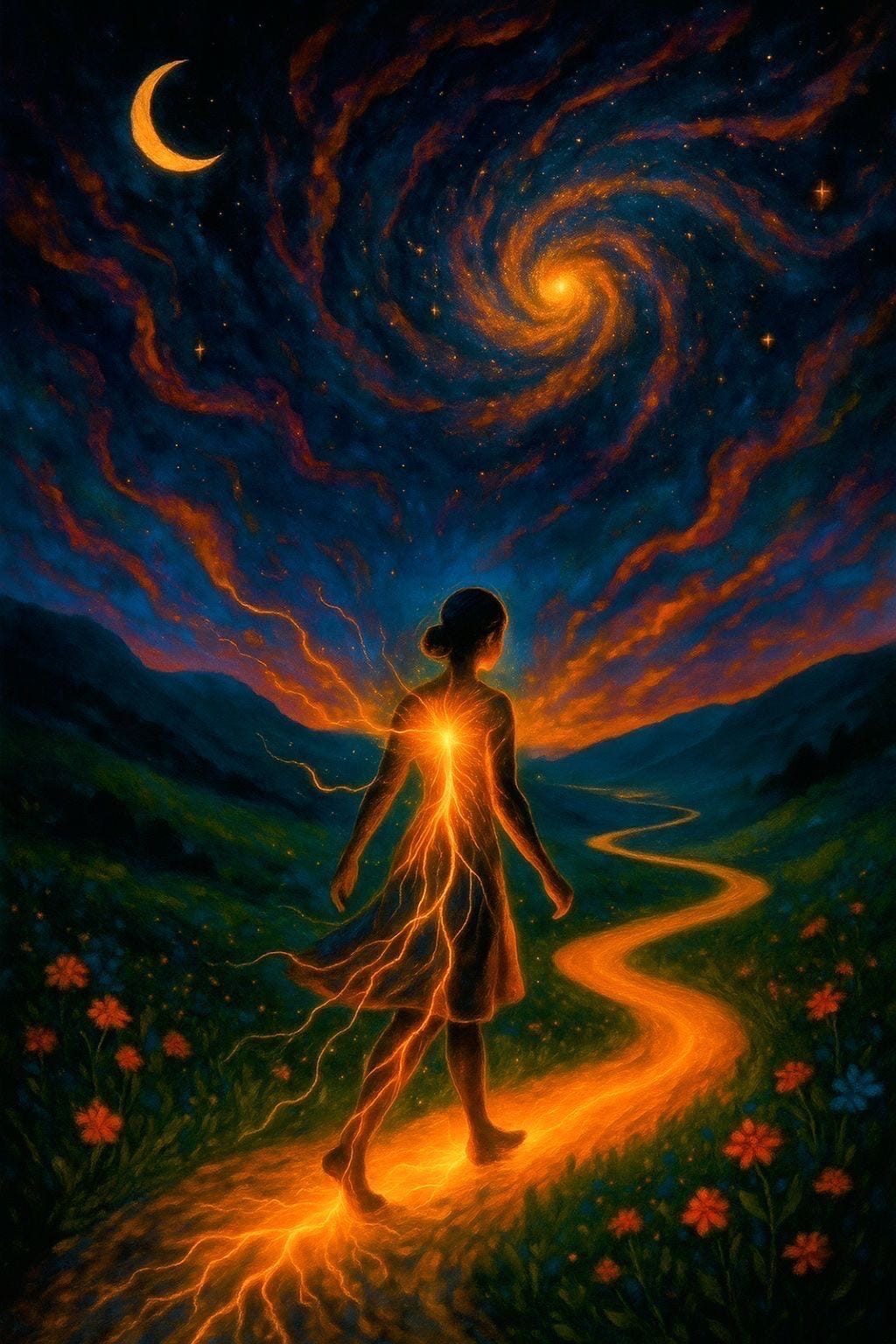
In our last essay, we explored how fire was one of humanity’s oldest religious symbols. We reflected on the fact that, no matter where we were on Earth, fire eventually became intertwined with the metaphor of conscious awareness. The flame became something that illuminated the world around us, and eventually, the world within us.
But why is it that fire became associated with awareness rather than, say, earth or water?
To understand this, first, I want to return briefly to a concept we’ve touched on before. Since the start of our intelligence series, kick started by the zodiac sign Gemini back in June, we have talked about twins, pairs and duality extensively. But we are not done. In fact, we probably never will be, as this is a theme we will keep coming back to over and over again in many different ways.
Because while reality itself is a vast spectrum of things, our brains tend to divide the world into categories. From an evolutionary perspective, the mind evolved to make quick distinctions. Is this safe or dangerous? Food or poison? Friend or stranger? Alive or dead? Day or night? A brain that can quickly categorize had a survival advantage selected for. Duality, then, is a cognitive shortcut for navigating the world we found ourselves in.
It’s a primitive and fundamental part of our intelligence as a species. We can’t escape it, hard as we try, but this does not necessarily mean that reality itself is fundamentally divided. Like I said, it’s more likely to be a spectrum, but no one fully knows it for what it really is, outside our perception of it. One compelling aspect of duality that appears to our human senses is relational. Instead of isolated things existing first, what exists first are relationships and differences. In that view, “up” only has meaning relative to “down,” “inside” relative to “outside,” and “self” relative to “other.” Dualities aren’t illusions, but neither are they independent absolutes. They arise together.
And so, in our pursuit of understanding, we are essentially exploring dualities from many different angles and points of view.
This brings us back to our earlier question. Our relationship with fire is one of duality because fire, like many things in the world, carries duality within itself. It isn’t just heat. It is also light. It offers both properties at once, and in the space between the two, our species was supercharged. While heat warmed our bodies and our food, it was light that truly captured our imagination, and more specifically, our vision.
For humans, vision is our dominant sense. Although every part plays a role (we saw that when we explored how our hands shaped our psyche) much of the information our brains gather about the world arrives through our eyes. Light, paired with our faculty of sight, is a foundational aspect of our existence that came to shape so much of our embodied intelligence.
To truly grasp how connected vision is to every other experience, we have to look, pun intended, at the very sense that allowed us to perceive fire and light in the first place.
Imagine waking up tomorrow with no vision whatsoever. And I don’t mean a black screen, because black is still a visual experience, but nothing at all. Not even a concept of seeing.
Now imagine that wasn’t only your experience, but the experience of every living thing around you as well. As strange as that existence is, that’s exactly how it was in the beginning for roughly 80% of life’s history. The world, to the earliest life forms, existed mainly through pressure, sound, scent, and positioning. Organisms navigated reality exclusively through chemical gradients, physical contact, and temperature.
The earliest life emerged nearly 3.8 billion years ago, with simple light sensitive proteins evolving around 2.5 billion years ago. These allowed primitive organisms to distinguish day from night, but they could form no images. That would come much, much later. The world was not “dark” to these creatures. It simply wasn’t visual.
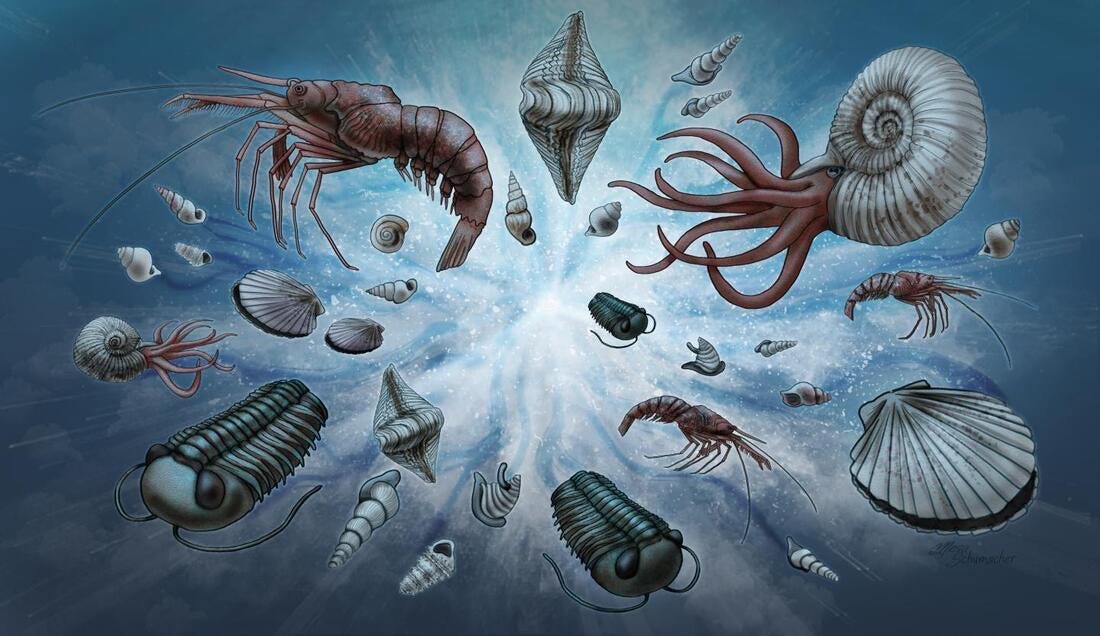
It wasn’t until the Cambrian Explosion, roughly 541 million years ago, that complex, image forming eyes swept through the animal kingdom. This biological leap triggered an evolutionary arms race between predators and prey.
In fact, eyes proved to be such an overwhelming survival advantage that they evolved independently between 40 (some say 65) separate times, giving rise to everything from the compound eyes of insects to the camera like eyes of octopuses.
What made vision so revolutionary was that it allowed the capacity for active, remote sensing. Unlike touch or taste, which require physical contact, vision maps a detailed, three dimensional environment almost instantly, with information traveling at the speed of light. Sighted animals could perceive threats and opportunities long before they arrived or could even be sensed.
Processing this flood of spatial data placed extraordinary demands on early nervous systems. In modern humans, roughly 30% of the cerebral cortex is dedicated to visual processing. Compare that to just 8% for touch and 3% for hearing.
As vision became more sophisticated, nervous systems expanded alongside it. Tracking moving prey, navigating complex terrain, and recognizing patterns and colours demanded greater brainpower. Better eyesight and larger brains coevolved in a tight feedback loop. Light did more than illuminate the physical landscape. It expanded the minds of many species across it.
On a side note, I can’t help but find this deeply metaphorical of the journey we ourselves take as humans, from fertilized egg to fetus to newborn. We begin in the complete darkness of the womb. There, touch is among our earliest ways of knowing the world. We feel our mother’s cocooning body, her warmth enveloping our own. We even taste the foods she eats through the amniotic fluid, and we begin to hear the steady rhythm of her heartbeat before later recognizing the soothing hum of her voice. Vision, though already developing, is the last sense to fully enter our experience. Only when we are born do we open our eyes to the light of the world.
The wonders above mirror the wonders below, and the wonders within mirror the wonders without. Fractals all around.
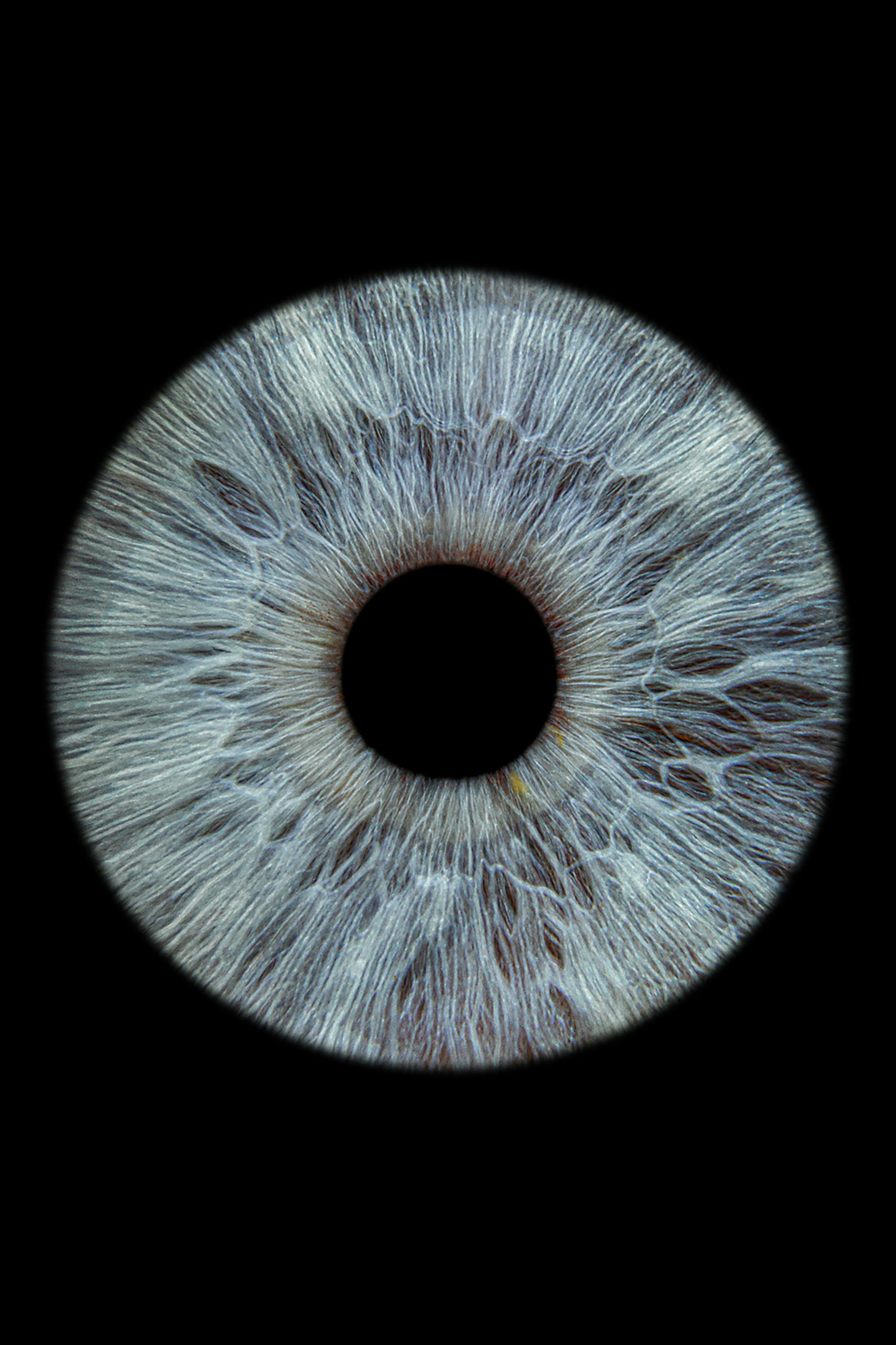
Because vision gathers information from a distance without physical contact, it naturally became our primary symbol for “knowing” what is hidden, abstract, or far away from us.
Vision also creates a natural boundary. The observer feels distinct from the object being viewed. That distance became the foundation for objective thought, analysis, and foresight.
According to Conceptual Metaphor Theory, the human brain frequently processes abstract concepts by recruiting the neural machinery originally built for physical experiences. Because our survival depended so heavily on what we could see, our cognitive architecture merged the two ideas. Our ancestral minds settled on a fundamental equation. To see is to know. Darkness, by contrast, concealed information and came to represent uncertainty and the unknown.
Here, we move from the duality of fire and light into the duality of light and darkness.
For much of our species’ time on Earth, light was a fleeting gift granted mostly by the sun. But sunlight was a fixed, distant, and indifferent force to our ancestors. The daily setting of the sun brought with it an absolute, dangerous darkness. One that halted activity and triggered a deep, primal sense of vulnerability.
Evolution is full of trade offs. Improving one ability often means another falls behind. Unlike the apex predators that evolved to hunt at night using specialized nocturnal vision, humans evolved primarily for daylight hunting. When darkness fell, it rendered many of our key adaptations ineffective. It became difficult to spot predators on the horizon, facial expressions and subtle cues of cooperation were nearly impossible to read, and communication quickly broke down as a result.
Physically, controlling fire allowed humans to manipulate where light fell. Psychologically, this mastery altered human consciousness. Light naturally signals safety and clarity to the brain, while darkness breeds anxiety.
Darkness functions almost as the mirror image of light in our cognitive metaphors. This comes from the lived reality of how darkness is to us on a physical level. We literally lose our sight in it, which makes us lose access to alot of information about our surroundings. This then became symbolically linked to ignorance itself in the mind and language.
Here are a few ways we describe states of ignorance using darkness:
“Kept in the dark.”
“A dark age”
“Obscure.”
“A shadow of doubt.”
“Out of sight, out of mind.”
“Turn a blind eye.”
“Blind faith.”
“A blind spot.”
At that point, the symbolism became nearly inevitable. on the other side of it, light is where we get information processing. Thus its linked to learning and awakening.
When we understand an idea, we say things like “I see”
You don’t just gain knowledge. Something is “brought to light”.
When we become aware of something we say “my eyes have opened”.
You don’t just miss a fact. You overlook it.
You don’t simply plan for the future. You have foresight. You get flashes of insight.
That is embodied cognition in action. The concrete experience of vision becomes the scaffold for abstract concepts like truth, wisdom, and awareness.
Here are a few more examples:
Vision = Wisdom and Foresight
“A visionary.”
“Seeing the bigger picture.”
“Looking ahead.”
“Far sighted.”
“Short sighted.”
“Hindsight is 20/20”
“Foresight.”
“Having perspective.”
Eyes = Character and Mind
“The eyes are the window to the soul.”
“I could see it in their eyes.”
“A knowing look.”
“A vacant stare.”
“Eyes full of wonder.”
“Sharp-eyed.”
Across world mythologies, this physical capacity was elevated into the divine through the image of the All Seeing Eye. Deities are said to know everything because they see everything.
In Norse mythology, Odin traded a physical eye for cosmic vision.
In Eastern traditions, the Ajna Chakra represents higher intuition as a Third Eye seated in the forehead.
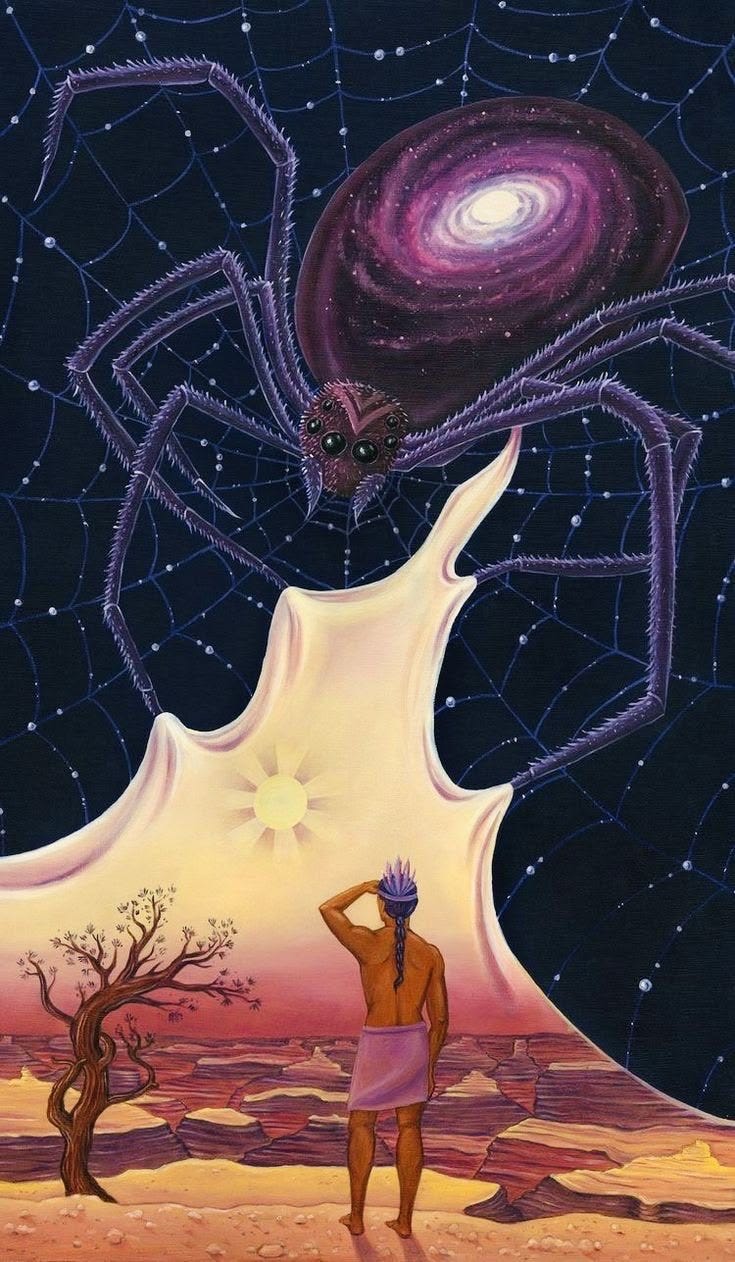
As humans began weaving myths and religions across the world, light became deeply linked to the awakening of the mind, symbolizing wisdom, clarity, and the journey from darkness into enlightenment.
Firelight was local, portable, and responsive to human command. It was humanity’s first successful rebellion against the tyranny of the natural clock, transforming Homo sapiens from passive witnesses of light into its active masters. By taming light, we began to push back the boundaries of the unknown.
Harnessing light also became a metaphor for harnessing the mind. We were no longer at the mercy of the unconscious. We could consciously think, reason, and choose when we wanted. Even the words that describe the properties of light, such as “reflection/reflecting” came to be used for thinking and contemplation.
Modern neuroscience offers an intriguing parallel. Our brains do not contain literal flames, yet they communicate through countless electrochemical impulses. Interestingly, we still describe this activity using the language of fire. Neurons fire. Thoughts race and ignite across intricate networks of electrical activity, illuminating possibilities that did not exist a moment earlier.
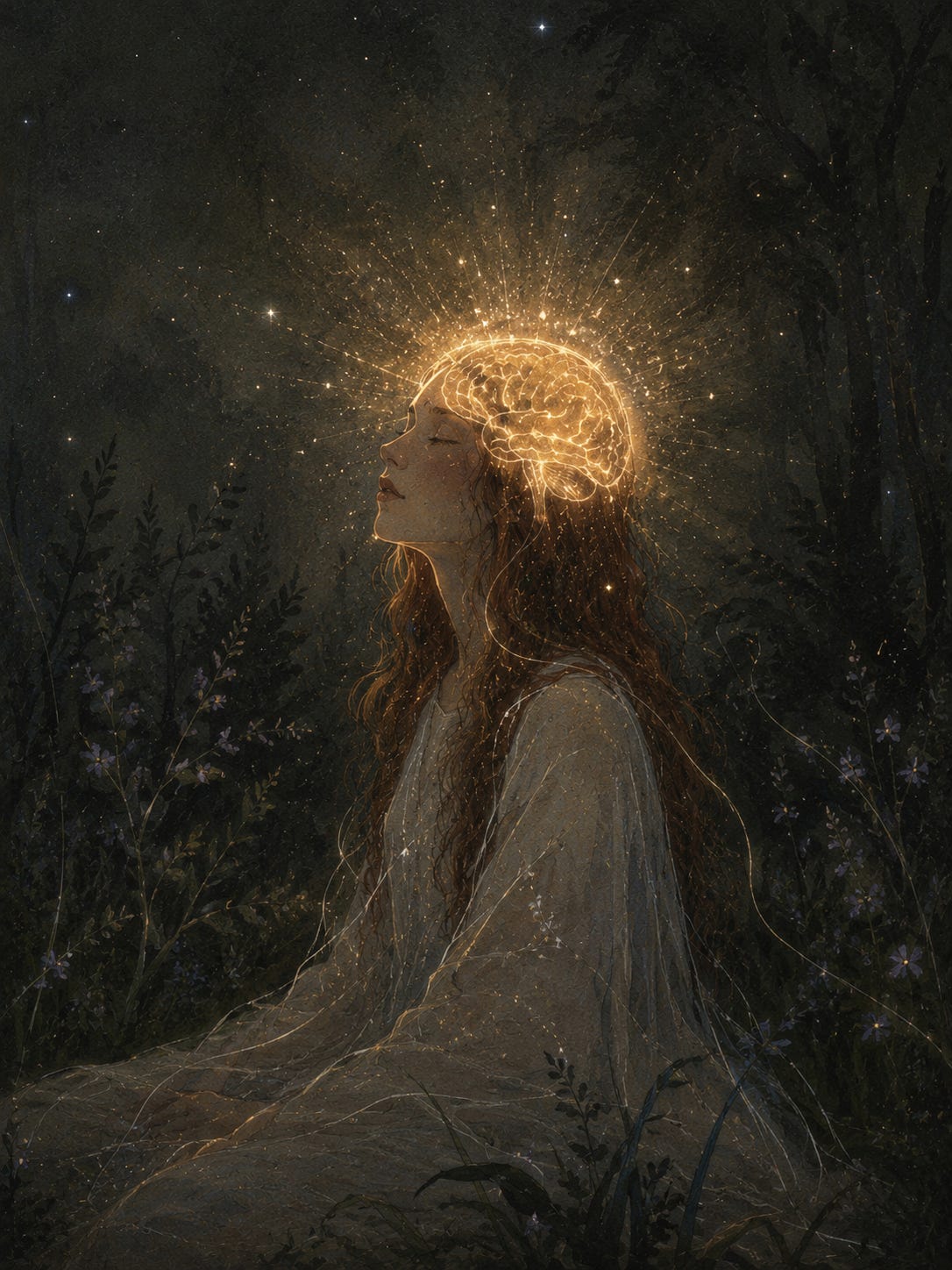
Light gave us vision and, with it, the faculty to perceive. But light alone cannot reveal everything. Eyes rooted in one place can see only so much, offering us just a small fragment of reality. To truly expand perception, movement had to accompany sight. For sight to evolve from seeing into imagining and to become the foundation of vision, foresight, and humanity’s greatest endeavors, we had to move through the world itself, exploring what lay beyond the horizon.
Next time, I look forward to following this new thread with you, dear friends, before we continue our journey into even more mythology as promised, where we will continue discovering more and more about ourselves through the world of storytelling and science combined.
Till then!! 👀
You continue to demonstrate that science and mythology are less adversaries than complementary languages describing the same terrain from different elevations. This piece quietly advances that conversation. The progression from embodied vision to symbolic awareness feels earned, and your treatment of light as both evolutionary adaptation and cognitive metaphor carries genuine "something new under the sun" energy. Outstanding work.✍🔥
You wrote: "Instead of isolated things existing first, what exists first are relationships and differences… Dualities aren't illusions, but neither are they independent absolutes. They arise together." That sentence quietly outranks everything around it, and the essay is good. Because if relations come first, then the observer/observed boundary you trace to vision — the distance you say founded objective thought — must itself be one of the pairs that arise together, not a wall that was already standing. Which makes your closing turn the real cliffhanger: once the eye has to move to see, the seer keeps trading places with the seen. So when you pick up the movement thread — does the traveling eye dissolve that observer boundary, or deepen it? Genuinely curious which way the series jumps. (And "neurons fire" as the ember of the whole fire-lineage — lovely catch.)